

Understanding and Detecting Pain in Osteoarthritis and Degenerative Disc Disease
Pain is one of the most important clinical signs in animals and humans with musculoskeletal disorders. In chronic, degenerative conditions such as osteoarthritis and intervertebral disc degeneration, pain often develops gradually and is recognised only once the disease is already advanced, which limits opportunities for early and effective intervention. Complicating matters further, the severity of pain and functional impairment frequently correlates poorly with radiographic or structural findings: a joint or spine that looks severely affected on imaging does not always correspond to a severely affected patient, and vice versa.
Our research addresses this gap from two connected angles. First, we investigate the biological mechanisms that link tissue changes to the sensation of pain, to better understand why structural and clinical severity so often diverge. Second, we develop and refine objective tools to detect pain and lameness earlier and more reliably, in both dogs and horses, so that treatment and welfare interventions can be initiated before disease is far advanced.
How Joint Inflammation Drives Pain in Osteoarthritis
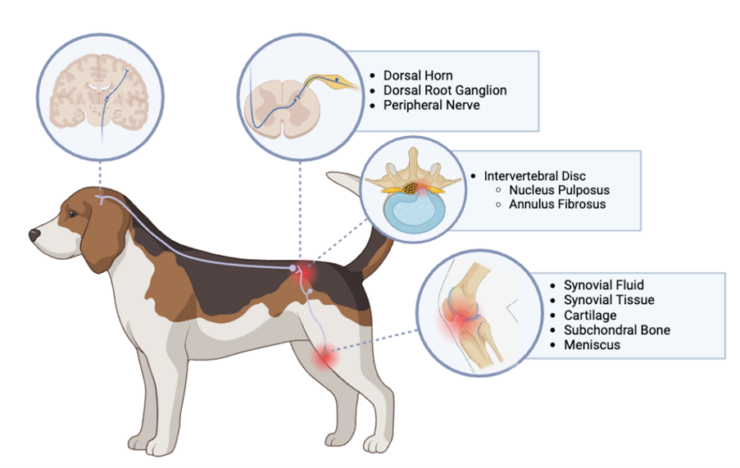
Osteoarthritis is increasingly understood as a disease of the whole joint rather than of cartilage alone. The synovial membrane plays a central role in this process: synovial inflammation contributes not only to structural joint damage but also to the sensitisation of pain pathways. At the same time, osteoarthritis is associated with progressive changes in the peripheral nervous system, particularly in the dorsal root ganglia, clusters of sensory neurons near the spinal cord that relay nociceptive and other sensory input from the joint to the central nervous system. Over the course of disease, alterations in these structures are thought to contribute to heightened pain sensitivity.
A central aim of our work is to establish how these tissue-level changes relate to what is actually observed in the clinic. In dogs with naturally occurring osteoarthritis, we correlate clinical pain and lameness scores with histological and molecular findings in synovial membrane and dorsal root ganglion tissue. This allows us to test, in a clinically relevant population, which biological changes are most closely associated with the pain a patient experiences, rather than relying solely on structural severity as a proxy.
Building on these findings, we are developing in vitro models that recapitulate key aspects of the synovial and neural changes seen in osteoarthritis. These models allow us to study the underlying processes in a controlled setting and to test how they might be modulated. This provides us with clues that will help us identifying new strategies for pain-targeted treatment, rather than treatment focused on structural repair alone.
Detecting Pain and Lameness Earlier
Because pain in animals cannot be self-reported, its detection depends on indirect measures: behaviour, posture, movement, and facial expression. Our research focuses on making these measures more objective and more sensitive to early-stage disease.
In dogs with osteoarthritis and low back pain, we use kinetic gait analysis to quantify movement and loading patterns that may not be apparent on visual assessment alone. We combine this with clinical pain scoring instruments to provide a more complete and objective picture of pain and functional impairment in dogs, supporting earlier diagnosis and better-informed treatment decisions.
In parallel, we apply more advanced gait analysis technology in horses, where systems such as Qhorse and Equi-Pro allow detailed quantification of forces, movement, and muscle activity. Insights and methods developed in this equine work inform our approach to canine gait assessment, and we are working towards translating comparable computer-vision-based analysis tools to dogs. By connecting mechanistic work at the tissue level with objective, quantitative assessment at the level of the whole animal, our research aims to close the gap between what happens inside the joint and spine and what can be reliably measured in the clinic. This ultimately supports earlier recognition of pain in animals and stimulates the development of better-targeted treatment in both animals and humans.
Involved researchers