

Back pain caused by intervertebral disc (IVD) degeneration is a chronic condition that profoundly impacts quality of life. Lasting pain relief requires more than symptom management; it depends on regenerating damaged tissue and restoring the disc’s natural biomechanical function. Current stem cell therapies provide only temporary pain relief and have yet to achieve true disc regeneration. Our research harnesses the unique regenerative and anti-inflammatory properties of notochordal cells to develop innovative therapies aimed at restoring disc health and delivering long-term relief for patients.
Cell-based therapy to regenerate intervertebral discs
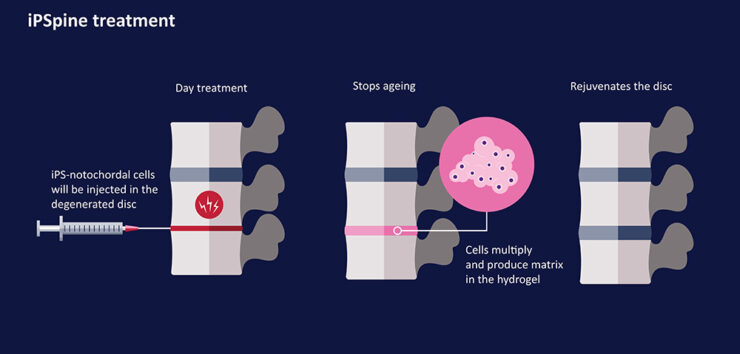
As part of the Horizon 2020 iPSpine project (2018 – June 2024), we developed strategies to differentiate induced pluripotent stem cells (iPSCs) into notochordal cells, the specialized cells found in healthy juvenile intervertebral discs. Combined with advanced biomaterials, these iPSC-derived notochordal cells are designed to rejuvenate degenerated discs by promoting tissue regeneration and restoring function. Following extensive pre-clinical evaluation, this regenerative approach progressed to a proof-of-concept study in canine patients suffering from chronic back pain, bringing the technology a step closer to clinical translation. Read more on the iPSpine website >>
Cell-free approach to rejuvenate the intervertebral disc
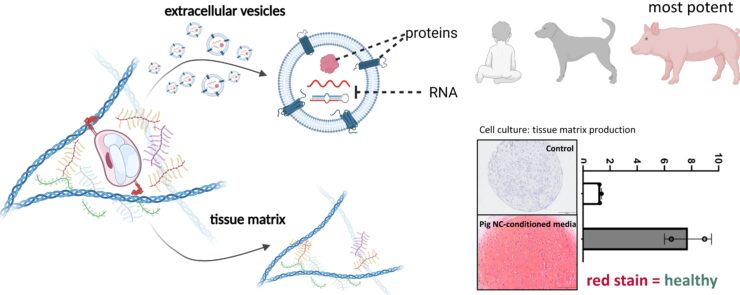
The Dutch Research Council (NWO) NC-CHOICE project (2022–2027) explores the molecular blueprint that drives intervertebral disc development during embryogenesis. By identifying the key signaling molecules responsible for healthy disc formation, we aim to harness these regenerative cues to restore degenerated discs. These bioactive signals are packaged into advanced synthetic nanovesicles and delivered within a specialized biomaterial that provides disc cells with a supportive, tissue-mimicking environment. Together, this injectable nanomedicine is designed to stimulate disc regeneration, restore function, and ultimately provide long-lasting relief from chronic back pain.
Involved researchers